A year after the Great East Japan Earthquake, the shop owners in Ebisubashisuji Shopping Street visited Minamisanriku Town in Miyagi Prefecture to volunteer and experienced first-hand the horror of the earthquake and the importance of disaster preparedness. In Tokyo, there were also many people who were unable to return home, and we faced the difficulty of responding to them.
Since then, large-scale earthquakes have continued to occur in various regions, including this year’s Noto Peninsula earthquake, and in the Hyuga-nada Sea, because it lies within the source region of a Nankai Trough earthquake, an advisory was issued for the first time. The government’s Earthquake Research Committee has raised the probability of occurrence to about 80% within 30 years.


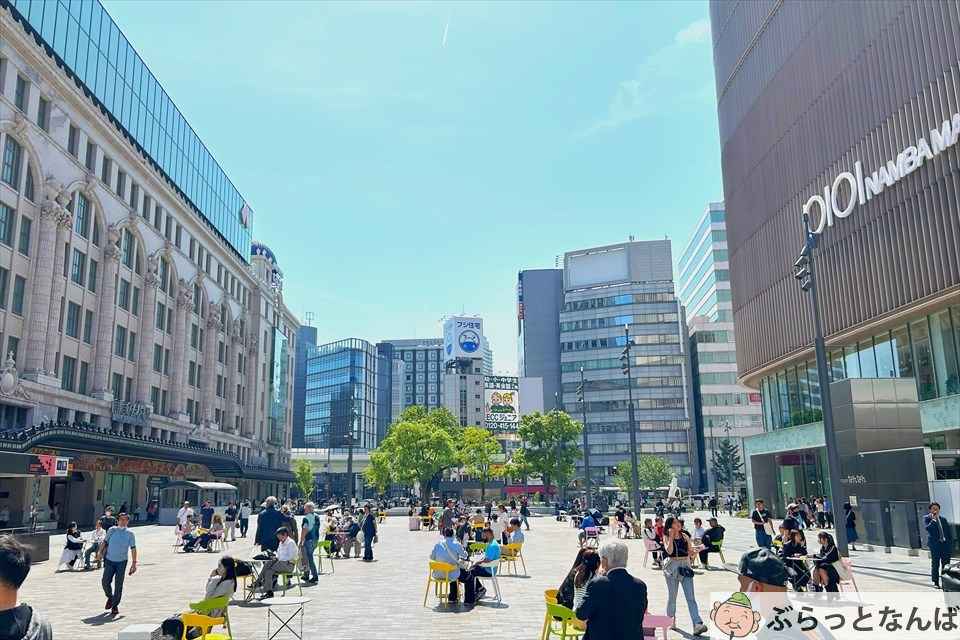
Many people come to Namba for work, shopping, and even sightseeing.
What would happen if a major earthquake occurred while you are in Namba? What about tsunamis? What about buildings? How should everyone act in response? What preparations are being made by the administration, the Namba shopping district, and businesses?

In this article, the office of the Ebisubashisuji Shopping Street will share information about disaster preparedness with those who visit Namba and those who work there.
When will the major earthquake expected to occur in the Osaka metropolitan area occur?
As major earthquakes affecting the Osaka metropolitan area, the trench-shaped "Nankai Trough earthquake" and the "Uemachi Fault Zone earthquake" caused by inland active faults are expected.
The Nankai Trough earthquake is an earthquake that occurs in the Pacific Ocean off Japan when the Philippine Sea Plate sinks beneath the Eurasian Plate. The probability of an earthquake of magnitude 8–9 is estimated at about 80% for earthquakes to occur within 30 years (as of January 15, 2025, according to the Earthquake Research and Investigation Promotion Headquarters Earthquake Research Committee, a government organization).
Furthermore, the committee has predicted the timing in more detail as follows.
In the Nankai Trough, major earthquakes have occurred at intervals of about 90 to 150 years over the past 1,400 years. Most recently, the 1944 Showa Tonankai Earthquake and the 1946 Showa Nankai Earthquake occurred; the previous committee predicted the interval until the next earthquake to be 88.2 years. Since the year of the Showa Nankai Earthquake, approximately 80 years have passed as of 2025; therefore, a major earthquake in the Nankai Trough is not impossible to occur at any time.
The next major earthquake is the Uemachi earthquake, which occurs in a fault zone extending from Toyonaka City to Kishiwada City.
The fault runs north-south through the area around Matsuyamachi-suji in Osaka City. Recent surveys have indicated that there is a fault that curves near the Shin-Naniwasuji Line in Nishi Ward and Naniwa Ward, both of which pass very close to Namba.
The estimated magnitude of the earthquake is between 7.5 and 7.8. The probability of it occurring in the next 30 years is 2 to 3%. Although the numbers may seem low at first glance, it is known that the probability of the Hanshin-Awaji Great Earthquake (magnitude 7.3) occurring was 0.02 to 8%. Therefore, it is by no means something to be taken lightly.
Let's take a look at the estimated damage from the major earthquake.
What will happen to the area around Namba after the major earthquake?
There are data published by the city of Osaka regarding the effects of the Nankai Trough Great Earthquake and the Uemachi Earthquake.
Namba is located in Chuo Ward of Osaka City, so let’s look at the estimated values for Chuo Ward and the entire Osaka City area.
The seismic intensity of the Nankai Trough megathrust earthquake is estimated at upper 5 to lower 6 on the Japanese scale. It is estimated that 2,200 buildings, approximately 13% of all buildings in Chuo Ward of Osaka City, will be completely or partially destroyed (across the entire Osaka City area, about 296,000 buildings, approximately 54% of all buildings, are expected to be completely or partially destroyed).
The number of deaths in Chuo Ward is 4, of which 1 is due to the tsunami. In the entire Osaka City, there are 120,000 deaths, of which 100,000 are expected to be due to the tsunami (2013 estimate).
The tsunami would reach the coastal area of Osaka City about 1 hour and 50 minutes after the earthquake and, after coming ashore, reach the west side of OCAT, where JR Namba Station is located, but it is not expected to reach Namba.
What will happen to utilities such as water, electricity, and mobile phones?
On the first day after the earthquake, almost all households in Osaka City are expected to lose water, 800,000 households, or 55%, to lose electricity, and about 300,000, or 22%, to have their gas cut off. It is estimated that 48% of fixed-line telephones and about 34% of mobile phone base stations will be out of service. Traffic services will be suspended, and the number of people who are unable to return home will reach approximately 870,000 in Osaka City.
What happened during the Great East Japan Earthquake? The government urged people not to rush home, and various facilities began cooperating to accept people for temporary shelter. However, by evening the main arterial roads were overflowing with people trying to walk home, traffic jams continued, and about 5.15 million people were unable to return home. Some people gave up partway home and fell ill, and emergency vehicles were unable to move because of the congested roads.

◆Regarding the announcement of the damage scenario (human casualties and building damage) for the Osaka Prefecture area due to the Nankai Trough (massive earthquake): Source: Osaka City Crisis Management Office (Osaka City website)
◆Seismic tsunami flood scenario from the Nankai Trough (massive earthquake) Source: Osaka City Crisis Management Office (Osaka City website)
The seismic intensity of the Uemachi Fault Zone earthquake is expected to range from upper 5 to 7, and it is estimated that 10,870 buildings, 70% of the buildings in Chuo Ward of Osaka City, and 55% of buildings across the entire Osaka City area will be completely or partially destroyed. The number of fatalities is estimated at approximately 2,200 in Chuo Ward (approximately 8,500 in the entire city of Osaka); the impact of an earthquake directly beneath the city would be enormous (fiscal 2006 estimate).
Next, I will talk about people who have difficulty returning home.
What is a person with difficulty returning home? How should you prepare for an earthquake in Namba?
People who have difficulty returning home are those who cannot return home because their home is far away, as well as those who walk home despite the long distance. Even if their home is relatively close, some people encounter various dangers along the way, such as collapsing buildings or falling objects, and give up on returning home.
According to a document published in 2023 by the Namba Station Area Council on Measures for People Unable to Return Home, 70,000 people commute daily to Namba for work and school, and 15,000 people who happen to be there for shopping, work, or as overseas visitors will be unable to return home,a total of 85,000 people unable to return homeare projected.
What would happen if everyone started moving in a rush to get home around Namba Station? Crowd-crush accidents, with people toppling like dominoes, could occur, and roads would become crowded with people, preventing emergency vehicles from passing through, hindering rescue, emergency medical response, and firefighting efforts.
To prevent the situation from getting worse, the first thing you need to do is not rush home. We have compiled a list of points that you should pay special attention to as a guideline immediately after an earthquake occurs (excerpted from the disaster prevention manual for shopping districts).
When going out, choose shoes that are as easy to walk in as possible and carry water with you.
(Employees who work in Namba should leave comfortable shoes at the company)
Do not approach buildings, walls, glass, or signs that are at risk of collapsing.
◆ It is difficult to travel more than 10 km on foot.Do not rush home and stay in a safe place。
(Namba Hiroba is not intended to be a refuge square, but rather as a place to disseminate information.)
◆ Do not travel by car, or call for a car to pick you up.(It prevents rescue and fire vehicles from passing.)
◆ Arrange with family and employees how to check on the safety of each other using the NTT Disaster Message Dial (171), SNS, etc.
◆ If you can use the Internet, "Osaka Disaster Prevention Net". In normal times, install the "Osaka Disaster Prevention App" in advance.
Osaka Prefectural Disaster Information App
Osaka Tourism Bureau Disaster Information
By the way, they say to stay in a safe place, but where should I take temporary shelter?
Companies and shopping districts around Namba Station are currently considering accepting temporary shelter.
There is no large park nearby Namba Station where you can temporarily take refuge. Namba Hiroba is also not designated as a place of refuge. It is a long way to Osaka Castle Park, which is a large-area refuge.
Therefore, in Osaka City, efforts are being made to consider measures such as temporary accommodation within facilities for those in need of assistance, drawing on the experience of the Great East Japan Earthquake, while calling on companies, organizations, schools, and other entities in the vicinity of major stations where the occurrence of many people unable to return home is expected to occur to cooperate.
In addition, to prevent confusion caused by people rushing to Namba Station, where trains are not running,Efforts to convey information using Namba Hiroba and Visionis being planned.

The Namba Station Area Council on Measures for People Unable to Return Home was established, and relevant parties are holding discussions and creating a “Manual for Handling Homebound Persons.” This manual is being made available to non-members of the council for their use.
Measures for people unable to return home during a major disaster Source: Osaka City Crisis Management Office (Osaka City website)
The Ebisubashisuji Shopping Street is an arcade street located between Nankai Namba Station and Dotonbori, so many people who are unable to return home are expected to stay in the shopping street. Therefore, even if there is a power outage immediately after the earthquake, we are using power generators to allow radio broadcasts and other information to be delivered to evacuees within the arcade. The store owners are training to actually operate this equipment.


At stores that are members of the shopping district, staff also do not rush home; after confirming safety, they stay in the store and assist visitors in need. They also keep three days’ worth of disaster supplies per person, including water, toilet coagulant, menstrual products, and a radio with a hand-crank charger.
Summary
A major earthquake can happen at any time, and if you were in Namba during an earthquake, many buildings would collapse and the railway and other vital infrastructure would be disrupted. Not only you, but if your family were visiting together, you could be left unable to return home.
In Namba Town, the shopping district, businesses, and the administration are working together to prepare so that damage can be reduced as much as possible.
You should also discuss disaster preparedness with your family and company on a regular basis and decide on how to confirm contact information. The tips and techniques introduced in this article will surely be useful. Please utilize them.

We deliver the latest information and useful tips and recommendations about Osaka Namba.